



Best Online Casino Game Shows in the UK
 Available in GB
Understand the studio, host-led presentation and game engine behind live casino game-show rounds.
How Live Casino Game Shows Work
A live casino game show combines a studio presentation with casino software. You see a host, a set and a physical game interface, while the platform records your bet, applies the relevant rules and settles the result. The studio supplies the visible broadcast; the game engine supplies the controlled logic behind the interaction.
This structure makes a game-show title different from a conventional slot. A slot normally presents a reel display and resolves a spin through software. A live show places the outcome inside a presented event, such as a wheel spin or another host-led round. The presentation may feel more immediate, but it does not remove the technical controls that govern a casino game.
The studio and the game engine
The studio is responsible for the live presentation. Cameras show the host and the physical equipment, while the broadcast gives players a shared view of the round. The host explains the stage of play and follows the procedure defined for that title.
This list highlights UK-licensed operators worth considering when exploring online casino game shows in 2026. Use the key details below to assess each option’s bonus, payout timing and minimum deposit.
License: UKGC Operator Licence · Bonus: £200 welcome bonus · Payout speed: Within 48 hours · Min. deposit: £10 32Red holds a UKGC Operator Licence and offers a £200 welcome bonus. Its minimum deposit is £10, with payouts processed within 48 hours.
License: UKGC Operator Licence · Bonus: £100 bonus · Payout speed: Within 24 hours · Min. deposit: £10 ProgressPlay Limited is a UKGC-licensed operator offering a £100 bonus. It lists a £10 minimum deposit and payouts within 24 hours.
License: UKGC Operator Licence · Bonus: £100 bonus · Payout speed: Within 24 hours · Min. deposit: £10 Genesis Global Limited operates under a UKGC Operator Licence and offers a £100 bonus. Players can deposit from £10, with payouts within 24 hours.
License: UKGC Operator Licence · Bonus: £50 bonus · Payout speed: Within 48 hours · Min. deposit: £10 Platinum Gaming Limited is UKGC-licensed and features a £50 bonus. The minimum deposit is £10, while payouts are made within 48 hours.
License: UKGC Operator Licence · Bonus: £20 bonus · Payout speed: Within 48 hours · Min. deposit: £10 Silverbond Enterprises holds a UKGC Operator Licence and offers a £20 bonus. It has a £10 minimum deposit, with payouts within 48 hours.
License: UKGC Operator Licence · Bonus: £100 bonus · Payout speed: Within 24 hours · Min. deposit: £10 LeoVegas is a UKGC-licensed operator offering a £100 bonus. Its minimum deposit is £10, and payouts are processed within 24 hours.
The game engine operates alongside the broadcast. It accepts the wager, applies the available betting options, records the round state and calculates the resulting settlement. It also connects the visible event with your account balance. If the game supports several outcomes, the engine assigns the correct result to the corresponding bet according to the published rules.
The important point is that the studio does not replace the software. A physical wheel or other piece of equipment may be visible, but the complete game still requires software to manage betting, timing, account balances and settlement. The engine must therefore meet the technical standards required for fairness and security in the UK market.
How random outcomes are handled
UK-facing game providers must use certified random number generator software to deliver random outcomes. An RNG is a software process designed to produce results without a predictable sequence. Certification does not mean that a particular result is favourable; it means that the outcome system has been examined against requirements for randomness and impartiality.
For a slot spin, the RNG generates the result, the game engine maps it to symbols and a payout, and each spin is independent of the previous one. Live game shows use a different presentation, but the same principle matters: the result for one round must not be inferred from earlier rounds. A sequence of similar outcomes does not create a technical obligation for a different result next time.
The broadcast also should not be treated as a signal that allows you to predict the next outcome. The host’s commentary and the visual setting explain what is happening, but they do not turn a random casino result into a skill-based forecast. Your wager is settled under the game’s stated rules, not according to an apparent pattern in previous rounds.

RTP and what it tells you
RTP means return to player. It is a long-run statistical figure describing how much of the money staked a game is designed to return across a very large number of plays. It is not a promise for one session, one round or one individual player.
UK-facing game providers must provide clear rules and RTP information. Before playing, you should be able to identify how the game works, which outcomes are available and how the stated RTP applies. This separates a measurable mathematical property from claims about whether a particular result is “due”.
Independent testing laboratories, including eCOGRA, iTech Labs and GLI, check whether RNG outcomes are random and unbiased and whether they correspond with the published RTP. Their role is to test the game system rather than predict its next result. A passed test supports the accuracy of the stated design; it does not change the variance of individual rounds.
What makes a live show different from a slot?
The main difference is the interface and the timing of the experience. A slot is generally built around repeated individual spins, with the software displaying symbols and calculating the payout. A live casino game show adds a broadcast, a host and a scheduled round structure. You observe the event as it unfolds instead of seeing only a reel result.
The underlying distinction should not be confused with a difference in certainty. Live presentation does not guarantee a result, and a physical-looking setting does not make the outcome controllable. The relevant safeguards remain the game rules, the certified random-outcome system, the published RTP and independent testing.
Age Requirement
You must be aged eighteen or over to gamble legally in the UK.
UK players must also be aged eighteen or over to gamble legally. That age requirement applies whether the game is presented as a traditional slot, a streamed table game or a host-led show. To understand a live game show properly, separate its visible production from its mathematical and regulatory components: the studio presents the round, the engine processes it, the RNG provides certified randomness where required, and the published information explains the game’s expected long-run return.
Which Live Game Shows You Can Find Online
Live casino game shows combine a hosted studio presentation with a ruleset taken from television game shows, casino table games or both. The result is not one single game type. It is a group of formats with different decisions, pacing, volatility and payout structures.
The provider controls the content: the studio design, presenter interface, game rules, graphics and underlying software. The casino brand does not create these shows itself. Specialist game providers develop the games, arrange independent fairness testing and license the finished products to casino operators. For you, the practical difference is that the show’s identity comes from the provider, while the casino mainly supplies access to it.
Wheel-based game shows
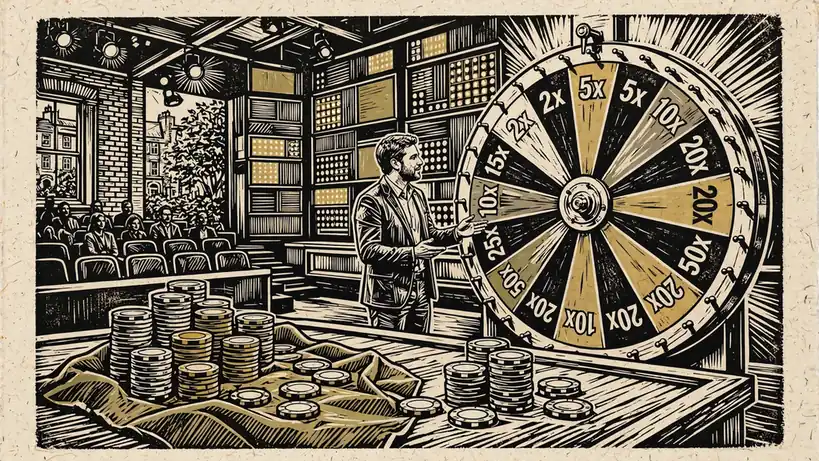
Wheel games are among the easiest live casino game shows to recognise. A presenter spins a physical wheel, and the result determines the next stage of the round. The wheel may contain cash values, multipliers, bonus symbols or segments that trigger a separate feature.
The basic format is simple, but the experience depends heavily on the wheel layout and the bonus rules. A wheel with many ordinary-value segments creates a different rhythm from one with several feature symbols. Some games keep the action on the wheel; others move the result into a bonus round with additional multipliers or choices.


This format suits players who want a visible event before the result appears. The physical wheel gives the round a clear beginning, suspense while it turns and a defined outcome. It also makes the result easy to follow on a mobile screen. The visual presentation does not change the mathematical rules, however. A segment still has the probability assigned by the game software, regardless of how long the wheel appears to spin.
When you compare wheel-based shows, look for the full rules and the published RTP rather than judging the game by its theme. RTP is part of the software, not a setting created by the hosting casino. The same game therefore retains its long-run RTP when it is offered through different operators.
Multiplier and prize-wheel formats
A related group uses a wheel or randomiser to select a prize category, after which multipliers or feature stages determine the final value. These shows are designed around variation: one round may produce a straightforward cash result, while another may enter a bonus sequence with a materially different payout structure.
The word “multiplier” describes the way a prize is modified; it does not mean that every result is multiplied or that a large payout is likely in each round. The rules specify which symbols, segments or events activate the multiplier. You should read those rules before treating a visible multiplier as part of the normal outcome.
This distinction matters when comparing the best live casino game shows for your own preferences. A game with frequent small events can feel active without having the same payout profile as a show that produces fewer but more substantial feature outcomes. The presenter’s energy and the speed of the broadcast may make both games look similar, while their underlying mechanics remain different.
A physical wheel determines the next stage, featuring cash values or multipliers.
Uses a wheel or randomiser to select prize categories and feature stages.
Combines real dealers and physical tables with game-show elements.
Adds theatrical studio settings or special bonus features to standard roulette.
A provider may also give a show a distinctive interface: animated prize displays, selectable boxes, escalating feature stages or a particular wheel design. Those elements affect the playing experience, but they do not replace the published game rules.
Live blackjack game shows
Live blackjack shows use a real dealer and a physical table, but may add game-show elements to the standard blackjack structure. The presenter deals cards in a studio, and the screen displays the player and dealer hands as they develop.
The core decisions are familiar: depending on the rules, you may choose actions such as hitting, standing, splitting or doubling. The exact options, dealer rules and payout conditions must be checked in the game information because they define the mathematical behaviour of that table.
Game-show versions can add side bets, extra presentation layers or multiple betting areas. These additions should be treated as separate propositions rather than as improvements to the base game. A side bet can have its own result conditions and RTP, distinct from the main blackjack wager.
The live video changes how the game is delivered, not the independence of individual outcomes. Cards already dealt do not create a guarantee about the next card, and a previous result does not make a particular future result “due”. The software and studio procedures are designed to run the stated game; they do not use a player’s recent results to compensate for earlier wins or losses.
Live roulette and game-show roulette
Roulette is another common foundation for live casino game shows. A presenter spins a physical wheel, and the ball settles into a numbered pocket. You can place wagers on individual numbers, groups of numbers, colours or other sections defined by the table.


Game-show roulette may add a more theatrical studio, a fast visual interface or special bonus features. The important question is whether the feature changes the rules of the roulette game or simply presents the same betting structure in a more elaborate way.
For standard roulette betting, each spin is a separate event. The fact that the ball landed on black, red or a particular number in the previous spin does not alter the next spin. The wheel’s presentation can make the outcome feel personal or dramatic, but the physical result remains governed by the game’s stated rules.
Read the table information carefully when a show uses named bonus bets. A bonus feature is not automatically part of every wager, and its payout conditions may differ from those of the principal roulette bets. The clearest comparison is made by separating the base roulette rules from the additional feature.
Dice, cards and randomiser shows
Some online casino game shows use dice, cards or a digital randomiser instead of a wheel. The presentation may still resemble a television contest: the host reveals an outcome, the screen displays a prize ladder and the round moves through visible stages.
Dice formats are often mechanically direct. A roll may determine a number, a multiplier or whether a feature continues. Card-based shows can use draws, comparisons or selections from face-down options. Randomiser formats may present a sequence of symbols or values generated by the game engine.
The apparent simplicity can be misleading. A show may offer several betting choices, and each choice can have different conditions. If you select a wager based on a card comparison, that is not the same proposition as selecting a wager based on a colour, rank or bonus event. The interface may place them next to one another, but the rules remain separate.
- Check the game’s published rules and RTP.
- Verify the casino’s UKGC licence.
- Use the casino’s official payment methods.
- Predict outcomes based on previous rounds.
- Assume a physical setting makes results controllable.
- Use a credit card for gambling transactions.
The game engine maps the outcome to the displayed result and payout. In an RNG-based element, the random number generator produces the result, and the engine converts it into the symbols, event or payment shown on screen. Each outcome is independent of the previous one. A sequence of losses does not create a mechanical obligation for the next round to win.
Pick-and-reveal shows
Pick-and-reveal formats ask you to choose from displayed options such as boxes, cards, doors or symbols. The host then reveals the selected outcome, sometimes followed by further choices.
This structure creates a stronger sense of participation than a simple spin. You may decide which item to reveal, but the choice does not necessarily give you control over the underlying probability. In some games, the selection only determines how the result is presented. In others, the rules may define different prize distributions for different choices.
The rules should tell you whether the selection is made before a random outcome is generated or whether the software has already assigned outcomes to the displayed positions. Without that information, it is not possible to infer an advantage from choosing a particular box or card.
Pick-and-reveal shows are therefore best assessed through their published rules and RTP, not through visual patterns. A previously successful position does not become more valuable, and a position that has not produced a prize is not automatically overdue.
Number-draw and bingo-style shows
Number-draw formats use drawn numbers, symbols or combinations to decide the result. Bingo-style shows can add a card, a collection mechanic or a prize ladder, while other versions use a simple number comparison.

Their pace is often different from wheel games. The result may build one item at a time, allowing the presenter to announce each stage. This creates suspense without requiring complicated player decisions. The key variation comes from the number of possible outcomes and the way matched combinations are paid.
If a game offers several cards or betting fields, check whether each field is an independent wager and whether the displayed prize applies to all selections. The visual layout can make multiple choices look like one combined bet, but the rules determine how the stake and payout are calculated.
Bingo-style presentation should not be confused with a guarantee of frequent prizes. The draw process still follows the probabilities and payout structure published for that game.
Slot-style live game shows
Some live game shows borrow the visual language of slots: symbols appear in rows, bonus symbols trigger features and multipliers can change a prize. The difference is that the game is presented through a live host or studio interface rather than as a conventional unattended slot screen.
The underlying logic remains software-based. For a slot-style outcome, the RNG generates the result, the game engine maps that result to symbols and a payout, and each spin is independent of the previous spin. The presenter may explain or celebrate the result, but does not choose it.
This is useful when comparing a live show with a standard slot. The live format changes the atmosphere, pacing and presentation. It does not make the outcome more predictable, and it does not turn a random result into a skill decision. The published RTP remains the relevant long-run measure for the game itself.
Understanding Live Shows
- The studio handles presentation, while the engine manages the logic and settlement.
- RNG software ensures random outcomes regardless of the visual format.
- RTP is a long-run statistical figure, not a guarantee for a single session.
- Live shows borrow the atmosphere of TV contests but follow strict mathematical rules.
Games that use expanding reels, extra ways to win or cascading features may feel more complex because one initial result can trigger additional stages. Each stage is still governed by the rules of that title. Terms such as “ways”, “reels”, “multipliers” and “bonus rounds” should be read as technical descriptions, not as indications of how often a large payout will occur.
How providers change the experience
Different game studios are associated with different volatility profiles and gameplay styles, according to a specialist industry review. Treat that as a description of provider tendencies, not a guarantee attached to every title from a particular company. Volatility describes how a game’s results may be distributed over play; it does not predict the next round.
Provider design is also visible in the studio itself. One supplier may emphasise a television-set atmosphere, with a presenter and a large physical prop. Another may prioritise a compact interface, faster rounds or more information on the betting screen. Neither presentation changes the game’s published rules, but it can affect which format you find easier to follow.
Casino-provider relationships can also include early access or exclusive releases, according to the same type of specialist industry review. Such an arrangement concerns availability, not a different probability model for the game. If the title is the same, the relevant rules and RTP remain those of the software.
When comparing live casino game shows online, separate three questions:
- What is the format? Wheel, cards, roulette, dice, number draw, pick-and-reveal or slot-style.
- What decisions are available? Some games involve only selecting a wager; others add choices during a bonus feature.
- How is the outcome produced? It may come from a physical studio process, an RNG-driven feature or a combination of both.
That framework prevents the presentation from being mistaken for the mathematics. A polished studio, an experienced presenter and a dramatic reveal can make a game engaging to watch, but they do not remove randomness. Check the rules, RTP and betting conditions for the specific title before comparing it with another live show.
Casinos That Host Live Game Shows
A live game show is supplied by a game provider, but the casino is the service layer through which you access it. That distinction matters when comparing online casinos with live game shows in the UK. The provider creates and maintains the game content; the operator makes it available, processes your money, checks your identity and applies the rules that govern your account.
Casino operators pay to host provider games on their platforms, while providers receive a revenue share. A casino listing several providers therefore needs the relevant commercial and technical arrangements with those studios, then has to integrate their catalogues into its website or app. The result is more than a lobby of games. It is an account, payments system, compliance process and support channel wrapped around the content.
What the casino adds to the game
The game itself is not rewritten for every casino. Where the same title appears at more than one UK casino, its underlying game remains the same; the surrounding service can differ. This point comes from a profile review rather than a universal market rule, so treat it as a comparison observation, not a guarantee about every title or operator.
The operator controls the parts of the experience that sit outside the game software:
- which provider catalogues are available;
- how live games are grouped and displayed;
- which payment methods can be used;
- the terms attached to promotional offers;
- identity and account checks;
- withdrawal handling;
- customer support;
- account limits, self-exclusion and other safer-gambling controls.
Online casino platforms provide game aggregation, payment processing, KYC, compliance tools and customer-support systems. Aggregation means that one account interface can present content from several providers. KYC is the identity-check process used to establish who you are and whether the account can be operated. Compliance tools support the operator’s duties under its UKGC licence.
This is why a provider name alone does not tell you which casino is suitable. Two sites can show the same live game but differ in the way they handle deposits, withdrawals, verification requests, support contacts and account restrictions. Withdrawal speeds, bonus terms, payment methods and customer support are determined by casino operators rather than game providers. That statement is based on a profile review, so compare the specific operator’s published terms rather than assuming that all casinos using the same provider work alike.
UKGC licensing and the operator’s responsibility
For gambling services offered to consumers in Great Britain, the operator must hold a remote operating licence from the UK Gambling Commission. The Gambling Act 2005 is the primary legislation governing gambling in Great Britain, and the UKGC maintains a public register of current operating and personal licences.
UKGC Verification
You can verify a casino by checking its operator name or licence number against the public UK Gambling Commission register.
You can verify a casino by checking its operator name or licence number against that register and confirming that the domain shown there matches the website you are using. This is important because a familiar brand name is not, by itself, evidence that a particular domain is authorised for Great Britain.
Providers supplying content to UK players must also be licensed by the UKGC or work with operators that are licensed. UK-facing providers must meet technical standards for fairness and security, use certified RNG software where random outcomes are required, and provide clear rules and RTP information. Those requirements concern the game supply. The casino’s licence concerns the operation of the gambling service around that supply.
The legal gambling age is 18. A UK-facing online casino must not make gambling available to people under that age. Remote operators must also belong to GAMSTOP, the national online self-exclusion scheme. These are operator-level protections, not features supplied by a live game-show studio.
Comparing catalogue size without confusing totals
A large games figure does not necessarily mean a large live-show selection. A platform may count slots, table games, instant games and live content together. It is therefore useful to separate three questions:
- How many total games does the platform advertise?
- Which game providers are represented?
- How many live game-show titles can you actually access after registration, verification and any regional restrictions?
A profile review reports that Genting Casino carries 81 providers and more than 5,000 games, including Playtech, Blueprint Gaming, NetEnt, Pragmatic Play, Nolimit City, Hacksaw Gaming, Push Gaming, Big Time Gaming and Evolution live casino. The same source reports that Mega Casino carries 73 providers and more than 5,000 games, with an exclusive Playtech relationship for early access to new releases. These are source-specific claims, not fixed market-wide measurements. Catalogues can change, and the headline total does not identify how many entries are live game shows.
The same caution applies to Slingo. A profile review describes more than 6,000 games and 50 or more exclusive Slingo Originals titles unavailable elsewhere. That may matter if exclusivity is your priority, but it does not automatically make the site the best choice for live game shows. Exclusive Slingo content and live broadcast game shows are different content categories.
A more useful comparison starts with the titles you intend to play. Search the casino’s live lobby for the provider and format, then check whether the title opens in the UK-facing account environment. A catalogue page can contain a provider logo without proving that every listed game is currently accessible to every customer.
Platform examples: SkillOnNet and Jumpman Gaming
Some casino brands are connected by a shared platform or technology provider. SkillOnNet operates under UK Gambling Commission licence number 39326 and powers the online operations of PlayOJO, Winlandia and Genting Casino. A profile review places the SkillOnNet platform at approximately 4,000 games. That figure describes the platform’s reported inventory, not a promise that every connected brand exposes the same games or the same live-show lobby.
This distinction is practical. A shared platform can supply common infrastructure, but individual brands may present different promotions, navigation, account messaging or available content. Before depositing, inspect the specific site’s terms, payment page, support route and responsible-gambling controls rather than relying on the name of the platform behind it.
SkillOnNet also agreed to a £305,000 UK Gambling Commission settlement in 2023 concerning anti-money-laundering and social-responsibility failings. That is a recorded regulatory event, not a statement that every current interaction on every connected brand will have the same outcome. It is relevant when assessing the operator group and the importance of checking current regulatory information.
SkillOnNet Platform
The SkillOnNet platform powers brands like PlayOJO and Genting Casino, managing approximately 4,000 games across its network.
Jumpman Gaming provides another example of the difference between brand variety and technical variety. A profile review says that it powers more than 200 visually distinct but technically similar casino sites, including RocketPot and Spinzino. The number describes the group’s reported site network; it does not establish that each site offers a distinct live game-show catalogue.
For you as a player, the relevant question is not how many logos belong to one network. It is whether the individual casino gives access to the live titles you want and provides acceptable account conditions. Check the legal operator, the UKGC register entry, payment options, verification requirements, withdrawal terms and support contacts for that particular domain.
Payments, verification and withdrawals
Live game-show software does not process your deposit or approve your withdrawal. Those functions belong to the casino operator and its payment and compliance systems.
Before making a deposit, check:
- which payment methods are available to UK customers;
- whether the method supports withdrawals as well as deposits;
- what identity documents may be requested;
- whether account verification must be completed before a withdrawal;
- how the operator describes withdrawal processing;
- how to contact customer support if a payment is delayed or rejected.
Do not use a credit card for gambling transactions. The relevant payment choice is the one supported by the operator under its UKGC-regulated service, not a method advertised by the game provider.
KYC can affect the path from a winning balance to a completed withdrawal. The game provider cannot remove an operator’s identity, anti-money-laundering or safer-gambling obligations. If an operator asks for information, the request belongs to the account relationship with that casino, even when the balance was built while playing a provider’s live show.
This also explains why a game can feel identical while the cash-out experience differs. The provider controls the content supplied to the casino; the casino controls the account ledger, payment workflow and support response.
Bonuses and responsible-gambling controls
Promotional terms are another platform-level difference. A bonus advertised beside a live game show is offered by the casino, not by the studio that built the game. Read the applicable terms for eligibility, game restrictions, expiry conditions and any withdrawal conditions before accepting an offer. Do not infer the terms from the game’s title or provider logo.
The operator must prompt new customers to set a deposit limit before the first deposit. Players must be able to stop playing at any time and retain the remaining deposit and winnings earned from that deposit. Remote operators must also provide access to GAMSTOP.
Platform choice affects self-exclusion coverage, withdrawal processing times, payment methods and responsible-gambling tools. A responsible-gambling comparison should therefore examine the account controls directly:
- Can you set or change a deposit limit through the account?
- Is the self-exclusion route clearly explained?
- Are support contacts visible before a payment problem occurs?
- Can you stop play without losing the remaining balance?
- Does the site identify the licensed operator and its UKGC details?
The same controls do not come from the game engine. They come from the operator and the platform supporting the account.
A practical comparison method
When comparing live game shows casinos in the UK, use the following order:
- Confirm the operator. Match the casino name and domain with the UKGC public register.
- Check the live catalogue. Look for the specific provider and game-show titles you want, not just a large total-games claim.
- Separate provider from platform. The provider supplies the show; the operator supplies the account, payments, verification and support.
- Read the payment terms. Confirm available methods and the stated withdrawal process before depositing.
- Review safer-gambling controls. Set the required deposit limit, check self-exclusion information and confirm that GAMSTOP participation is stated.
- Assess the account service. Look for clear KYC instructions, support channels and operator details.
This method avoids treating catalogue size as the only measure of a good online casino with live game shows. The content must be available, but the platform determines how you access it, fund the account, verify your identity, withdraw funds and apply account protections.
Crazy Time, Funky Time and Other High-Variation Shows
Crazy Time and Funky Time are live casino game shows built around a wheel rather than a conventional slot reel or a standard card table. Their appeal comes from visible choices, bonus segments and the possibility of moving from a simple wheel result into a more elaborate feature. The same structure also creates a higher-variation playing experience: outcomes can differ sharply from one round to the next, and the most prominent features may appear less frequently than ordinary wheel results.
How Crazy Time fits the format
Crazy Time is associated with Evolution, one of the named game providers available in the UK market. The game uses a large studio wheel divided into numbered and feature sections. A presenter spins the wheel, and the result determines the next stage of the round.
Crazy Time Process
The presenter spins the large studio wheel to determine the outcome.
The result lands on either a numbered section or a feature symbol.
If a feature symbol is hit, the round transfers to a specific bonus game stage.
The bonus rules dictate the subsequent outcome and the final prize.
The numbered sections form the basic layer. A result on a number pays according to the applicable game rules, while a feature result moves the round into a bonus game. This separation matters because the wheel outcome is not equivalent to a guaranteed bonus. A feature symbol is an instruction to enter another game stage; it does not mean that every round will produce the same type of return.
The bonus stages are the reason Crazy Time is treated as a high-variation show. They introduce additional decisions or selections after the main spin, so the result depends on more than the initial wheel position. The studio presentation makes each step visible, but visibility does not give you control over the underlying outcome. You can choose where the rules allow a choice, yet the available values and the final result remain governed by the game system.
For a player, the practical model is therefore:
- The wheel generates the initial outcome.
- A number produces the relevant number-game result.
- A feature section transfers the round to a bonus stage.
- The bonus rules determine the subsequent outcome and payout.
This is different from a slot in presentation, but not from a slot in the important fairness principle: each round is treated as an independent event. A previous bonus result does not make a feature result “due”, and a sequence of ordinary outcomes does not change the next spin.
What Funky Time changes
Funky Time is another live wheel show from Evolution. It uses the same broad category of mechanism: a presenter-led wheel, standard result sections and feature sections that open additional game stages. Its identity comes from its own visual design, presentation and bonus structure rather than from copying the exact appearance of Crazy Time.
That distinction is useful when comparing the two games. They belong to the same family, but the show title does not tell you whether the games have identical rules, identical payouts or identical volatility. You need to open the individual rules and RTP information for the specific game. UK-facing game providers must make rules and RTP information clear, and those details are the proper basis for comparison.

Funky Time can therefore suit players who want the wheel-show format but prefer a different presentation and feature arrangement. It should not be selected on the assumption that a familiar title guarantees a particular result pattern. The name identifies the product; the published rules describe how that product behaves.
Why these shows feel high-variation
Variation is experienced through the distribution of results, not through the presenter’s energy or the size of the studio. A round can end at the basic wheel stage, while another round can enter a bonus feature with a different result path. That creates a wider visible range of outcomes than a game where every spin ends with a single reel combination.
Three mechanisms contribute to that impression:
- Feature separation: bonus sections occur as distinct wheel outcomes rather than as part of every round.
- Multi-stage results: entering a feature adds another outcome stage after the initial spin.
- Uneven result sizes: the rules can assign different values to different sections and feature outcomes.
None of these mechanisms changes the random nature of the game. The game engine still applies the published rules to the result produced for that round. Independent testing laboratories such as eCOGRA, iTech Labs and GLI check whether random outcomes are unbiased and whether performance matches the published RTP.
Choosing between the named shows
If you are comparing Crazy Time with Funky Time, start with the rules rather than the title. Check the available wheel sections, the conditions for entering feature rounds, the bonus-game instructions and the published RTP. Then decide whether the format matches the level of variation you are prepared to accept.
The casino hosting the game does not rewrite the provider’s core game mathematics. It may affect access, account procedures, payment handling and withdrawal processing, but the show’s rules remain part of the licensed game software. A UKGC-licensed online casino should also provide the responsible-gambling controls required for its customers, including deposit-limit prompts before a first deposit.

A profile review of Jumpman Gaming describes a catalogue of around 3,000 or more games, with strong emphasis on slots from NetEnt, Pragmatic Play and Microgaming. That catalogue detail does not establish that every Jumpman-powered site carries Crazy Time or Funky Time, so availability must be checked on the specific casino’s lobby. The same profile review states that withdrawal processing can take one to three business days before funds are released. That is an operator-level detail, not a property of either game show.
Both titles are intended for adults aged 18 and over in Great Britain. Treat the bonus features as additional random stages, not as a method for predicting the next result, and use the published rules and RTP to understand the product before staking.
Which online casino game providers are the most reputable?
Reputable providers use independent testing laboratories such as eCOGRA, iTech Labs or GLI to verify that their RNG outcomes are random, unbiased and consistent with the published RTP. They must also meet UK technical standards and be licensed by the UK Gambling Commission or supply content through licensed operators.
What is the fastest payment method for withdrawals?
Withdrawal speed is determined by the casino operator rather than the game provider. Check the casino’s listed payment methods and withdrawal terms, as processing times and available options vary between operators.
Which slot provider is best?
There is no single best provider for every player. Different studios have different volatility profiles and gameplay styles, so compare the games, RTP information and provider catalogue available at the casino.
What is a UK gambling licence?
A UK gambling licence is authorisation from the UK Gambling Commission to offer gambling services or supply gambling content to UK players. Licensed businesses must meet UK requirements for fairness, security and responsible gambling.
What are the requirements for obtaining a UK gambling licence?
Applicants must meet UK Gambling Commission requirements for fairness, security, technical standards and responsible gambling. Game providers must also use certified RNG software and provide clear rules and RTP information.
Created by the ”Guide Casinouk Gb” editorial team.